
MMM vs Attribution vs Incrementality: What’s the Difference?
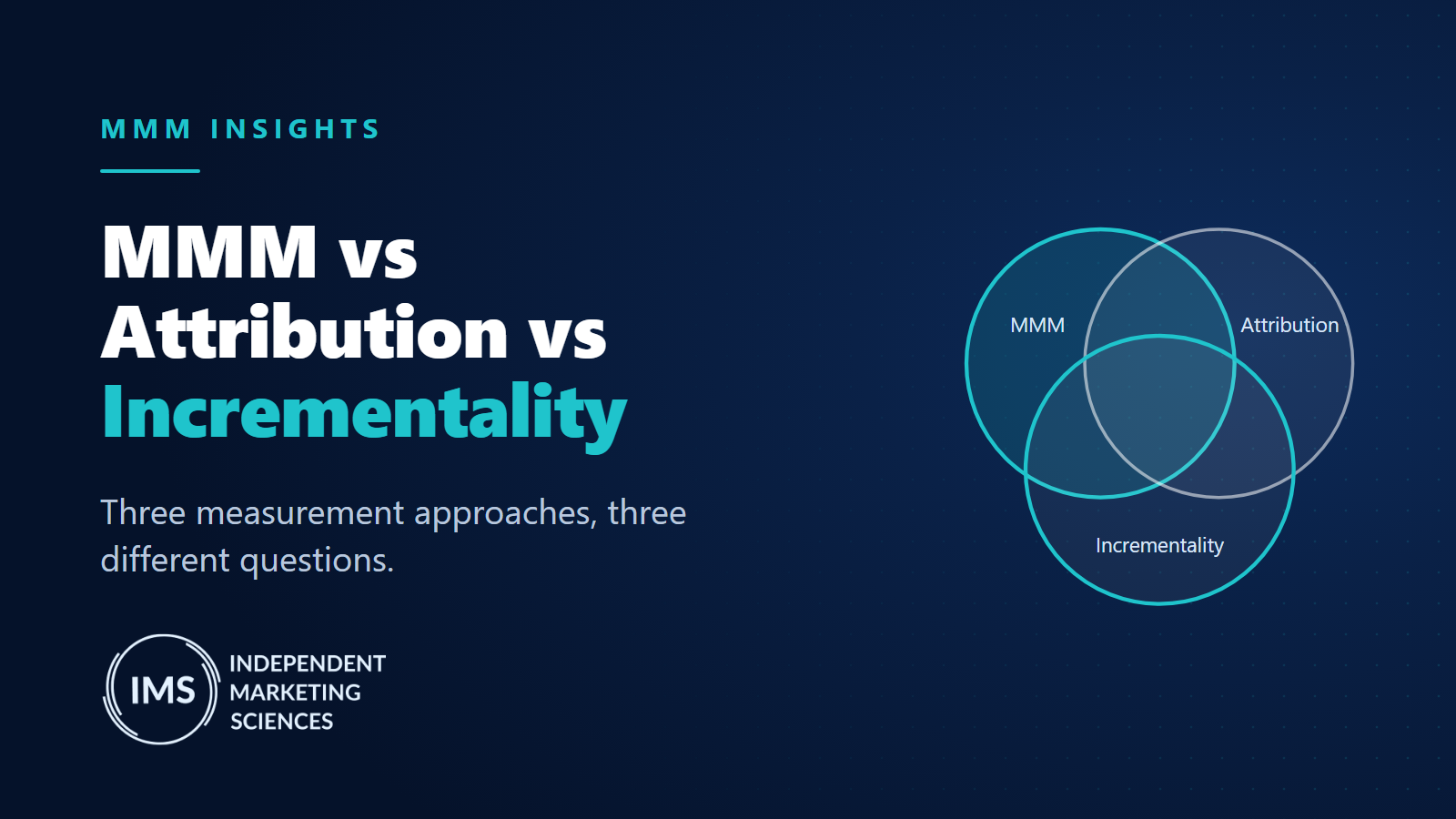
Marketing Mix Modelling, attribution and incrementality get used almost interchangeably in marketing conversations. That’s a problem, because they answer different questions, and mixing them up leads to bad budget decisions. Here’s what separates them.
What attribution does
Attribution assigns credit for a conversion to one or more touchpoints in a customer’s journey. Say a customer sees a social advert, clicks a paid search ad a few days later, visits the site and buys. An attribution model splits the credit for that purchase across some or all of those touchpoints, usually paid search and social in this case.
The appeal is obvious: it connects specific marketing activity to an individual customer’s path to purchase. The catch is everything attribution can’t see. People who would have bought anyway, offline activity, brand advertising, customers on devices or browsers it can’t track, and other forces such as promotions or seasonality all sit outside its view. Attribution is useful for understanding the journeys it can observe. It’s weaker as evidence of what caused a sale.
What incrementality does
Incrementality asks a sharper question: what additional sales happened because of this activity that wouldn’t have happened otherwise?
The distinction matters more than it sounds. If a customer was always going to buy, an advert they happened to see beforehand can still get credit in an attribution model, even though it changed nothing. Incrementality isolates the difference marketing actually made, usually through experiments such as holdout tests, geo experiments, regional tests, A/B tests or controlled market trials. A common version pulls advertising back in a set of regions while keeping everything else as similar as possible elsewhere, then compares sales.
What MMM does
MMM looks at the relationship between marketing and business outcomes across the whole business, over time, instead of at individual customers or specific tests. It uses aggregated data (sales, spend by channel, promotions, pricing, seasonality) to estimate how much each factor contributed.
Where attribution asks “which touchpoint gets credit for this customer’s purchase?”, MMM asks “across the business, how much did each channel contribute to sales?” That makes it particularly good for judging the overall shape of a budget, including channels such as TV or out-of-home that are hard to tie to an individual customer at all.
Side by side
| Approach | Main question it answers | Best suited to |
|---|---|---|
| Attribution | Which touchpoints received credit for a conversion? | Digital customer journeys, campaign-level reporting |
| Incrementality | What additional outcome did marketing cause? | Testing whether a specific activity works |
| MMM | How did marketing and other factors contribute to overall performance? | Strategic budget allocation across the full mix |
Which one should you use?
They aren’t really competing. Attribution earns its place in campaign reporting and in understanding digital journeys. Incrementality earns its place when you need direct evidence that a specific activity is working. MMM earns its place in annual and quarterly budget planning, and in measuring the channels the other two can’t reach cleanly.
Most businesses that take measurement seriously end up using more than one: attribution for campaign reporting, experiments for testing specific bets, and MMM for the big allocation decisions. Each covers a gap the others leave. For a closer look at how MMM is evolving within that mix, read How Brands Should Use MMM in 2026.
Why the distinction matters
A channel can look strong in attribution and still generate very little truly incremental sales. Equally, a channel that attribution barely credits (brand TV is the usual example) can contribute meaningfully to growth in ways a touchpoint-based model was never going to catch.
The question worth asking isn’t “which channel gets the most credit?” It’s “which activity is growing the business, and where should the next pound go?” That’s harder to answer, and it’s where a broader measurement framework, one that doesn’t lean on a single method, earns its keep.
The short version
Attribution, incrementality and MMM answer different questions, and none is simply a better version of the others. Attribution explains observed digital journeys but doesn’t prove causation. Incrementality, usually through experiments, isolates the causal effect of a specific activity. MMM gives the business-wide view, including channels that can’t be tracked at individual level. Most mature set-ups combine more than one.
Frequently asked questions
Can attribution and MMM give conflicting numbers for the same channel?
Yes, and that’s expected rather than a sign something’s broken. They measure different things in different ways, so some disagreement is normal. If the gap is large, investigate it, but it doesn’t automatically mean one model is wrong.
Is incrementality testing a replacement for MMM?
No. Incrementality tests are excellent for validating a specific channel or campaign, but running enough tests to cover an entire marketing budget is usually impractical. The two work best together, with test results used to sharpen and validate the model. What Is Marketing Mix Modelling? explains how it fits together.
We only have attribution data right now. Is that a problem?
It’s a starting point, not the full picture. Attribution alone tends to overweight lower-funnel, trackable channels and underweight brand and offline activity. If budget decisions rest entirely on attribution, try an MMM or incrementality approach alongside it before making major reallocations.
If you’re trying to reconcile numbers from different measurement approaches, IMS can help you understand what each one is telling you, and where they should agree. Get in touch. You can also read about our marketing mix modelling and geo testing services.



Magda Pietrzykowska
Associate Analyst

Transform Your Data Into Your Most Valuable Asset
Connect with us and discover how our tailored analytics solutions can drive business success.
Contact IMS