
Bayesian Marketing Mix Modelling Explained
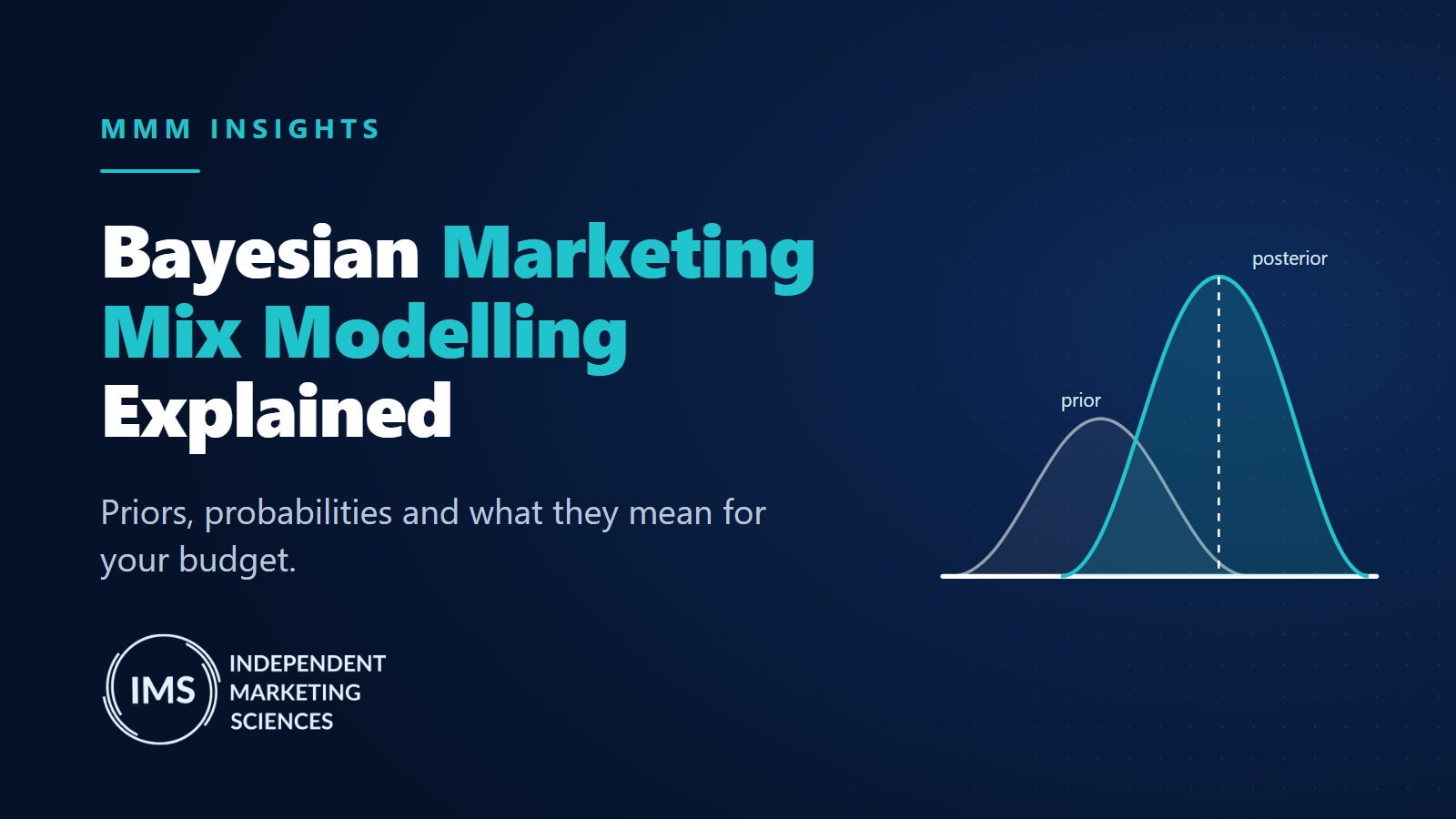
Bayesian Marketing Mix Modelling comes up constantly in modern measurement, and it sounds more intimidating than it is. Strip away the terminology and the idea is simple: combine what you already have good reason to believe with what your data actually shows.
Why this matters for MMM
Marketing data is rarely clean. Most businesses are working with some mix of limited history, channels that have changed a lot over time, activity that moves together (TV and paid social ramping up in the same weeks), very little natural variation in spend to learn from, and several influences on sales tangled together.
That last problem causes most of the trouble. If TV and paid social always rise in the same month, a model struggles to decide how much credit each one deserves. Bayesian methods don’t solve that by magic, but they give the model a sensible way to handle the uncertainty instead of guessing with false confidence.
What “Bayesian” means here
A Bayesian approach combines two things: what you reasonably believe already, and what the data says once you look at it. Three terms do most of the work.
| Term | In plain English |
|---|---|
| Prior | Your starting assumption, based on experience or general knowledge, before you’ve looked at this dataset |
| Likelihood | What the data suggests on its own |
| Posterior | Your updated view once the prior and the data are combined |
Start with a sensible assumption, look at the evidence, then update. Experienced analysts do this informally anyway. Bayesian methods make it explicit and mathematically consistent.
A simple example
Say you have good reason, from years of experience, to believe TV contributes meaningfully to sales, but this dataset covers only eight months. A Bayesian model can start from that reasonable expectation about how TV tends to behave and still let the data pull the estimate somewhere else if the evidence is strong enough.
The aim isn’t to force a pre-decided answer. It’s to stop the model producing something wildly unrealistic because eight months of data can’t support confidence on its own.
Does going Bayesian make the results more accurate?
No, and anyone who tells you otherwise is selling something. A Bayesian model is only as good as its data, its design, the assumptions built into it and the judgement of whoever validates it. “Bayesian” describes a framework, not a result.
Where it genuinely helps
It helps most when data is thin, because the model can lean on sensible prior knowledge instead of trying to learn everything from a small dataset. It also helps when you want honesty about uncertainty. Rather than “paid social generated exactly £2.4m”, you get a credible range, which reflects what the data can really support.
When several channels and outside factors move together, Bayesian methods give you a structured way to handle that ambiguity instead of picking a number and hoping. And they’re useful for scenario planning: because the uncertainty carries through every estimate, forecasts come with a realistic range attached, not a single figure dressed up as certainty.
What to ask a vendor about it
Whether a vendor uses Bayesian methods matters far less than whether they can explain how. Ask why a Bayesian approach suits your problem, which assumptions and priors they’re using and where those came from, how the assumptions change the results, how the model has been validated, and how uncertainty gets communicated back to you. Then ask whether the outputs actually help you make a decision.
If the answer to any of that is a shrug, that tells you more than the methodology does. Our guide on how to evaluate an MMM vendor goes through the wider checklist.
The short version
Bayesian MMM blends prior knowledge with observed data to give a more realistic estimate. It helps most when data is limited or noisy, or when several factors move together and are hard to separate. It isn’t a guarantee of accuracy, because the data, the design and the validation still matter most. And a credible vendor can explain their assumptions in plain English, not just defend them as technically correct.
If the term is new to you, start with What Is Marketing Mix Modelling? first.
Frequently asked questions
Is Bayesian MMM better than a traditional regression-based model?
It depends on the problem. Bayesian methods have the biggest advantage when data is limited or channels are highly correlated, since they can use sensible prior knowledge instead of relying on a small or messy dataset alone. Where you have plenty of clean, well-varied data, the practical difference is often smaller.
What is a “prior” in Bayesian MMM, and where does it come from?
A prior is a starting assumption about how a variable is likely to behave, based on past experience, industry benchmarks or general marketing knowledge. It isn’t pulled from thin air. It should be documented and justified, and a credible analyst can tell you exactly where theirs came from.
Can a bad prior make a Bayesian model worse than a non-Bayesian one?
Yes. A prior that’s too rigid or poorly chosen can drag the model towards an unrealistic answer, especially if it carries more weight than the data deserves. That’s why asking how a vendor sets and tests their priors matters more than asking whether they use Bayesian methods at all.
If you’d like to understand how a Bayesian approach would apply to your own data, get in touch with the team at IMS. You can also read about our marketing mix modelling service.


Magda Pietrzykowska
Associate Analyst

Transform Your Data Into Your Most Valuable Asset
Connect with us and discover how our tailored analytics solutions can drive business success.
Contact IMS